# HTTP API
Every function is an HTTP endpoint. Paths are relative to where the space is mounted.
POST /{slug}/invoke          run it: one request, one response
POST /{slug}/invoke-stream   the same, streaming what it prints (SSE)
POST /upload                 upload a file, when some function takes one
GET  /returns/{reference}    download a returned file
GET  /doc                    the contract of every function, in plain text
# /invoke
The body is a JSON object with one key per parameter:
import requests

response = requests.post("http://127.0.0.1:8000/divide/invoke",
                         json={"a": 10, "b": 2})
payload = response.json()

if "error" in payload:
    raise RuntimeError(payload["error"])

print(payload["result"])   # {"type": "text", "value": "5.0"}
Values use JSON as the form sends them: a date or a time as ISO text, an enum by
its member name, a dataclass as an object, a file by its
reference. A missing parameter takes its default.
When a union's branches cannot be told apart by their shape, the value says
which one it is with $type: {"$type": "list[str]", "$value": ["a"]}, or a
"$type" key inside the object of a dataclass. Each function's plan in /doc
shows the exact shape.
The response has exactly one key, result or error. result is one
output, or a list of them. The status code says whose problem it
was:
200   it ran, and returned
422   the input breaks the contract   {"error": "SchemaTypeError: b: expected float, got str"}
500   the function raised             {"error": "ZeroDivisionError: float division by zero"}
A function can be a plain def or an async def. A plain one runs in a thread,
so a slow function does not block the server.
# Streaming
/invoke-stream takes the same body and sends
server-sent events:
event: start
data: {}

event: print
data: {"text": "[ 40%] file 2 of 5\n"}

event: result
data: {"result": {"type": "text", "value": "5 file(s) converted"}}
print comes zero or more times, with what the function printed since the last
one; result comes once, with the same envelope /invoke returns. The status
is always 200, since the response has started before the function ends. This
is how the page shows a function's prints while it runs:
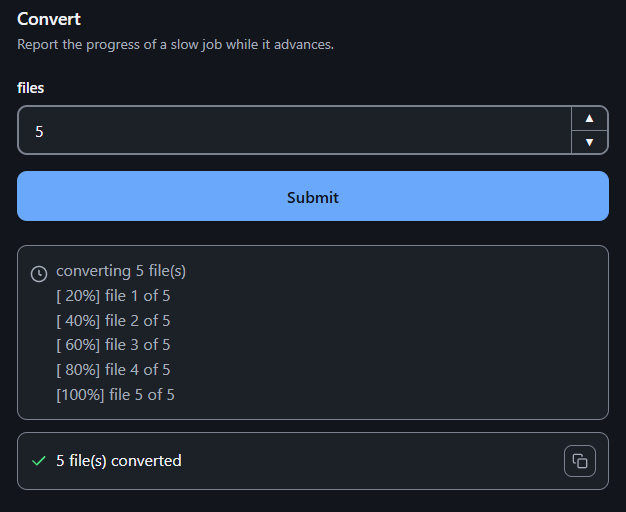
Capture is on by default. Turn it off for a whole space with
capture_prints=False, or for one function with
WebFunction(fn, capture_prints=False). It is experimental: it replaces
sys.stdout for the rest of the process, which can conflict with a test
harness or a library that also replaces it.
If the client disconnects, the function still runs to the end.
# Files from a script
Upload the bytes first, under a reference you choose, then call the function with that reference:
POST /upload
Content-Type: application/octet-stream
X-File-Reference: report-2026.pdf

<the bytes>
It answers 413 past max_upload_bytes, 409 if the reference already exists,
and 400 if it is not a valid file name. A returned file is downloaded at
GET /returns/{reference}, where the reference is the value of its
download output.
# /doc
A plain-text document with everything a client needs: the functions, how to call
them, the outputs, and each function's full contract (types, defaults,
constraints). It is written once when the application is built, names only the
routes that exist, and writes <base_url> for the prefix, so an agent reads it
and knows how to call the space.
How it works inside
Print capture. The first function with capture that runs replaces
sys.stdout with a dispatcher, and it stays for the life of the process. Every
write goes to the original stdout and also to the execution that made it,
found by its thread or its async context, so two calls never mix their output.
Something that replaces sys.stdout afterwards leaves capture without effect;
something that wraps it too ends up nested with it.
Polling. While the function runs, the stream wakes every 50 ms to send what is pending, so an event can be up to 50 ms late and each open stream costs that wake-up. For internal tools with a few users, neither is noticeable.
Static assets. /static/{path} serves page.js, page.css, sdk.js and
the widgets of pytypehintweb, with an ETag and one hour of cache, so every
function of a space shares them. Every URL a page requests is relative, which is
why a space works under any prefix. The content type is fixed by extension
(.js, .css, .svg), because mimetypes reads the Windows registry, where
.js is often text/plain.